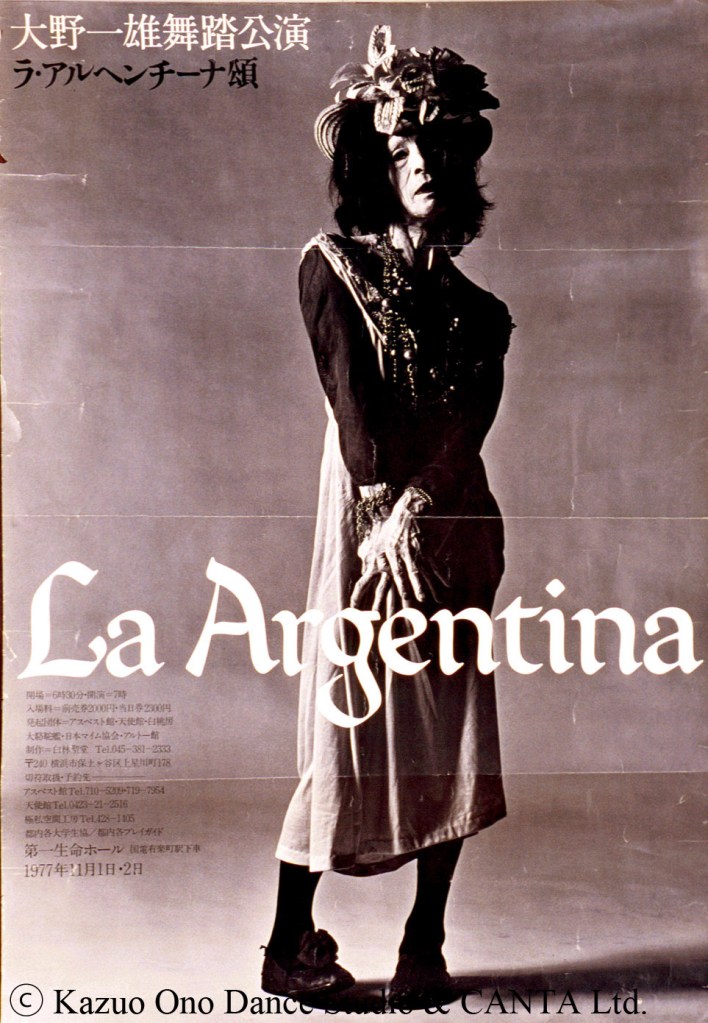
“How graceful Kazuo Ohno is, dancing in an antique dress.”
── Kazuko Shiraishi, Those Who Paddle Out into Space: A Canoe, a Logbook of a Voyage, 1977
Kazuo Ohno (1906 -2010) was one of the most impressive performers who pioneered Japanese avant-garde dance called “舞踏 (Butoh)”. His performances become renowned internationally at Festival de Nancy in 1980, where he and his son Yoshito collaborated through the stage titled Admiring La Argentina. Kazuo was in his 70s at that time.
The costumes definitely played an essential role throughout his performances. Kazuo chose to put women’s dresses in many stages with its style on the “antiquity” and “old-fashioned”.
Butoh was developed around in 1960. When it comes to its definitions, today’s expressions often combine elements of modern dance and traditional arts, so it’s not easy to define them as one distinct type. However, it is believed that its origin comes from art of German Expressionism exploring to Japan about early 1920s.
Kazuo was born in Hakodate, Hokkaido. While he worked as a gymnastic teacher at Christian school, he started dancing, which initially followed Western modern dance. He was tall, being physically gifted as a male dancer.
It has been suggested that Kazuo first incorporated cross-gender dressing in 1959 when he was 53, in Kinjiki (Forbidden Colors), inspired by Yukio Mishima’s novel, a collaborative work involving his son Yoshito (1938-2020) and another remarkable butho dancer,Tatsumi Hijikata (1928-1986). Tatsumi asked Kazuo to act Devine, a male prostitute who dressed as a woman, who was a character from Notre-Dame des Fleurs (1943) by French author, Jean Genet. In the novel, Devine was crushed by despair and ultimately decays into old age and death.
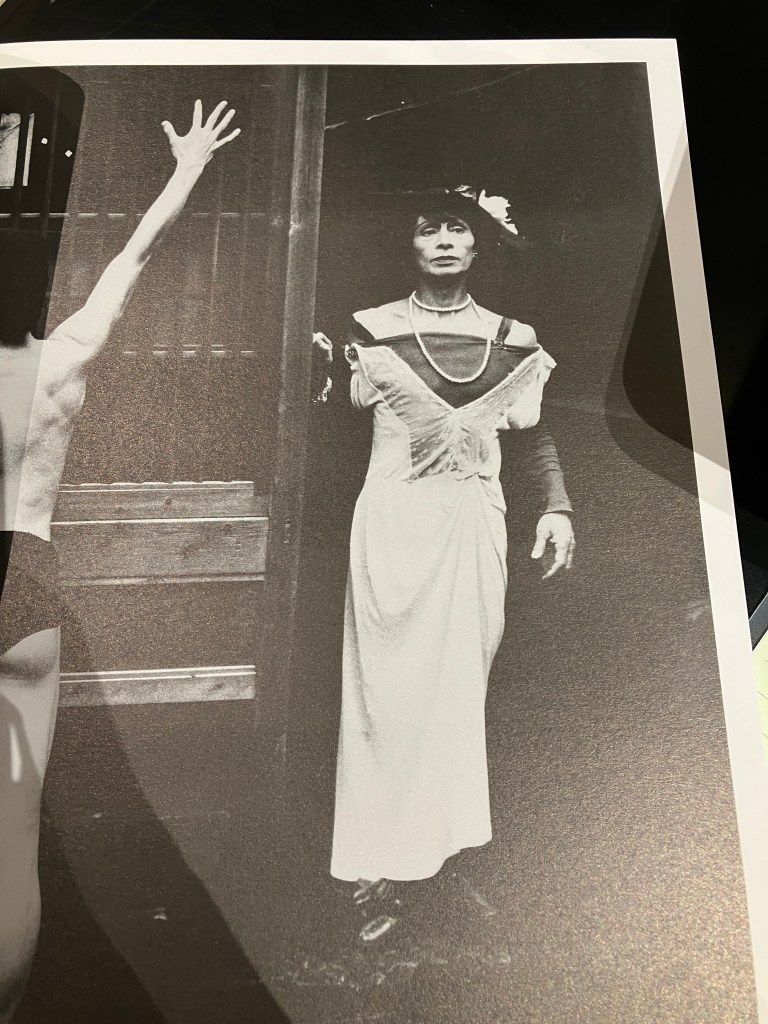
Kinjiki consisted of two almost naked young male dancers and the role of Devine acted by a middle-aged man attired in women’s dresses, which caused the public controversy with its homoerotic choreography. Kazuo interpreted the appearance through his own sense. He applied a white makeup and wore an old-fashioned lady’s hat adorned with artificial flowers, along with a ripped negligee-like a dress with perl necklaces. He had no hesitation in representing himself through more extravagant makeup and costuming as it was acted repeatedly.
Admiring La Argentina stands as one of Kazuo’s most representative works, rooted in his lifelong devotion to the Spanish female dancer Antonia Mercéy Luque (1890-1936), who came to Japan in 1929. The first act was staged in 1977, and the Dance Archive Network notes that the costumes were styled by a female dancer Matsuyo Uesugi at that time, although there are no specific information to capture the design details.
Butoh is a highly improvisational form of dance, and even a part of different work is inserted to another work, which dissolves boundaries between the performances. Admiring La Argentina was no exception. The opening of the work features choreography that can be interpreted as referencing the character of Devine.
The stage was revived numerous times, undergoing repeated revisions including its costumes. In the first stage in 1977, Kazuo wore a classical dress with floral headpiece. The dress evokes a silhouette of 1930s or 1940s fashion. He lifts his skirt and takes childlike steps and appears almost like a young girl.
After twenty years, the costumes of Admiring La Argentina offered different perspective. The decorated hat, the white lace mantle, long black lace gloves, the bold necklaces and rings along with the make up applied on his a wrinkled face ── were all layered onto over his aging body and movement.
Kazuo’s cross-dressing on stage began in his later middle age, and as he grew older, the antiquated quality of his appearance acquired increasing weight. Rather than a queer expression, his performance evokes a ghostly presence that transcends gender and ages, and the costumes could function as a crucial device that evokes in the audience a sense of something once touched somewhere in the past── at once nostalgic and unsettling.
This sense of antiquity lacks the “cleanliness” associated with health or perfection, instead, it bears the accumulation of various scars and stains or a dried-out, desiccated state that register the passage of time on the wearer’s body. the excessive appearance looks something grotesque with silent madness but also brings the most innocent quality.
After Kazuo passed away at age 103, his son, Yoshito joined a photo shoot with a fashion photographer Tim Walker for Vogue UK in 2016. During the session, Yoshito wore white makeup and costumes from Admiring La Argentina for homage to his father.

 MANAKO JOURNAL
Leave a comment