• Harriet Hosmer, who was one of the earliest successful female sculptors, on ladder with sculpture of Thomas Hart Benton, ca. 1861-1862. Wikimedia common.

    Where does fashion actually happen? Charlie Porter’s What Artists Wear sets out to articulate a lesser-told realm of “fashion” — one found not on the runway, but in artists’ wardrobes. I first encountered Porter’s book in Japanese translation 「アーティストが服を着る理由」 published in the summer of 2025. Porter explores distinctive and personal dimensions in various artists’ appearances. Each piece moves between the private and the public, the functional and the expressive, finding meaning in the space between them.

    The author who has a 20-year career as a fashion journalist casts a question about the situation in which “fashion” is always defined through runways where a dress is made for a fashion model’s body, and such narratives risk reducing fashion to fantasy. Porter specifically notes his desire to articulate fashion after “production”, which means dresses are interpreted by their wearers once off their producers’ hands (designers).

    Artists must negotiate between the demands of physical labour and personal expression. Sculptors, in particular, have a strong connection with their dress’s functionality. Porter notes that artists tend to wear the same clothes repeatedly — and sculptors are no exception.

    Sculptor, from the Occupations of Women series (N502) for Frishmuth’s Tobacco Company, 1889, The Metropolitan Museum of Art. JSTOR.

    The field had long been dominated by men. Sculptors traditionally required not only physical strength but also access to anatomical study to reproduce human figures. These requirements excluded women sculptors for centuries. This shaped certain assumptions about the role of dress in the studio. Porter’s book features female contemporary sculptors including Dame Barbara Hepworth (1903-1975) and Anne Truitt (1921-2004). Both offer compelling examples of how physical work shapes a women artist’s relationship to dress. Outside the pages of the book, another sculptor demands attention: Alina Szapocznikow (1926-1973), whose relationship to clothing and the working body tells a different story. Placing her alongside Hepworth and Truitt reveals just how varied — and how telling — a woman artist’s wardrobe can be.

    Dame Barbara Hepworth

    My first impression of Dame Barbara Hepworth’s looks was the way she styled accessories in photographs taken from 1940s to 1960s. While she habitually put on the same set of clothes in studios including a zip-up jacket, trousers, and a smock, she shows her freer choice of accessories. She often wore a scarf on her head and bold chain necklaces in her many portraits throughout her career. This styling for work seems to have been established as early as the 1930s when she was in the late 20s or early 30s according to her portrait from barbarahepworth.org.uk. In the photo, she was carving a stone forming a head, wearing a coat or smock and scarf on her head.

    As noted in Porter’s book, she told her friend in a letter some desire to develop her own “fashion style” inspiring herself in 1944. Whether this remark referred to her working dress or her appearance beyond the studio is uncertain but her words were seeking transformation of her looks reflecting her age and the shift between pre- and post-war eras.

    Her portraits from her later career in the late 1940s and 1950s for the public could indicate her settlement of her “artist style”, which shows her explicit preference for functional clothing of the clothes with her consistent manner of dress, but not without a clear sense of personal style. A resolute stance in her wardrobe implies some “well-kept attitude”, as shown in her fondness to fur coats in her private life after receiving Dame in England in the 1960s.

    [See: Barbara Hepworth in her studio, c. 1930s — barbarahepworth.org.uk]

    Anne Truitt

    On the other hand, American Ann Truitt took a different approach. Countless spots of paint on her clothes show accumulation of time for her creation. She did not mind getting her clothes dirty. The most widely known her portrait in her working style could be the photo taken in 1964 at her atelier in Washington.

    [See: Anne Truitt in her Twining Court studio, 1964— https://www.bridgemanimages.com/]

    She was standing between her sculptures in a set of paint-splattered quilting jacket and trousers. The photo is introduced in Porter’s book as well, and also mentioned the jacket that Anne’s daughter has inherited. The tag on the rugged quilting jacket said “for active Americans”, speaking to her commitment to her job too. The paint stains are mainly gathered around the waist, which allows us to guess at her physical habits.

    Her style seems distant from concerns regarding gender. As contemporary art had diversified including the material choices and more experimental styles had been adopted, the boundaries dictating the role of gender in artists’ dress. The plentiful paints on Truitt’s garments might have spoken more to her desire to be present as an “artist”.

    [See: a portrait of Ann Truitt in her paint-splatted jacket— https://www.annetruitt.org/bio]

    Alina Szapocznikow

    Alina Szapocznikow embodies another aspect of “female sculptor’s appearance” as one who lived in the same era as the other two did. I encountered her work by chance in a Japanese bookstore years ago — and it was not only the sculptures but her own appearance that immediately caught my attention.

    Szapocznikow was a Polish sculptor who survived the Holocaust and later studied in Prague and Paris, where she spent much of her working life. Entering her artistic maturity in the 1960s, she introduced new materials into her practice, including vinyl and polyurethane. Casting fragments of the human body in these materials, her works inhabit a space between vulnerability and tenderness, pain and intimacy.

    One series of photographs, taken for ELLE magazine in 1968, reveals her approach to dress most clearly. She was working on a large sculpture titled Petits Ventres, forming casts of two women’s bellies from Szapocznikow’s own body.

    [See: Alina Szapocznikow working on Petits Ventres, Italy, 1968. Photograph: Roger Gain for ELLE magazine. Via archiwum.artmuseum.pl]

    She sits in front of her work wearing a knee-length skirt, her legs uncovered, heeled loafers. While carving the stone, she did not layer any covers protecting her daily wear from dirt. Her looks are nothing like that of “a working artist at atelier”. The casual ease of her dress gives the image a sense of openness, befitting the spacious Italian studio in which it was taken.

    Szapocznikow’s dress styles had mysteriously multifaceted aspects. In one portrait outside of her atelier in 1950s, she was in a sleeveless, patterned and tight dress and pumps, holding a pose with a cigarette in front of a drawing. This series of photographs shows different versions of her style: the dress with a coat, gloves, scarves and hat. She seemed to enjoy being photographed in many different guises without her works in view.

    [See: Alina Szapocznikow in a sleeve-less dress, 1950s. Via archiwum.artmuseum.pl]

    [See: Alina Szapocznikow in a sleeve-less dress, a coat and scarf, 1950s. Via archiwum.artmuseum.pl]

    In her other style in the later 1960s, she wore a white feather boa around her neck, while holding piece of her works. The dark-coloured pull over had splattered paint in it, much as Truitt’s did, but the boa does not correspond to such physical vestiges. She also wore sunglasses as well in the portrait, and chose a black fur boa in another photo.

    She does not appear to have dressed deliberately, yet fashion was never incidental to her. Her dress choices were free from the restrictions that women should dress like women, but never abandoned “being a woman”. There were no specific uniforms to mark her as a “female sculptors at atelier”. One of the few colour photographs shows her in a vivid purple mini dress, sitting in front of her work, Duża plaża, (1968).

    [See: Alina Szapocznikow in a purple dress in front of her work, 1968. Via archiwum.artmuseum.pl]

    The human bodies, especially women’s bodies, was a crucial factor for Szapocznikow. She cast parts of women’s bodies from her own. The dismantled fragments were sublimated into her work. The sculptures were not merely monumental but also much more personal and empirical objects.

    She created L’enterrement d’Alina (Alina’s Funeral, 1970) after being diagnosed with breast cancer. She confined her personal possessions in the sculpture, including photos, gauze and underwear, which reveals a tangible connection with her identity—the things kept close to the body never entirely separated from the body of her work.

    Porter’s book asks what artists wear, and why it matters. These three women suggest that for female sculptors, the question runs deeper still — touching on how a woman chooses to exist in a body that makes, that labours, that is looked at. The wardrobe, it turns out, is one of the quietest and most telling places to look.


    References

    Books

    Filipovic, Elena, and Joanna Mytkowska, eds. Alina Szapocznikow: Sculpture Undone, 1955–1972. New York: Museum of Modern Art; Brussels: Mercatorfonds, 2011.

    Porter, Charlie. What Artists Wear [アーティストが服を着る理由]. Translated by Reina Shimizu. Tokyo: Film Art, 2025.

    Websites

    Anne Truitt Foundation. “Anne Truitt.” AnneTruitt.org. Accessed March 11, 2026. https://www.annetruitt.org.

    AWARE: Archives of Women Artists, Research and Exhibitions. “Alina Szapocznikow.” AWAREwomenartists.com. Accessed March 12, 2026. https://awarewomenartists.com/en/artiste/alina-szapocznikow/.

    AWARE: Archives of Women Artists, Research and Exhibitions. “Anne Truitt.” AWAREwomenartists.com. Accessed March 12, 2026. https://awarewomenartists.com/en/artiste/anne-truitt/.

    AWARE: Archives of Women Artists, Research and Exhibitions. “Barbara Hepworth.” AWAREwomenartists.com. Accessed March 12, 2026. https://awarewomenartists.com/en/artiste/barbara-hepworth/.

    Barbara Hepworth Estate. “Barbara Hepworth.” BarbaraHepworth.org.uk. Accessed March 11, 2026. https://barbarahepworth.org.uk.

    Culture.pl. “Alina Szapocznikow.” Culture.pl. https://culture.pl/en/artist/alina-szapocznikow. Accessed March 10, 2026.

    Meisel, Nina. “Sculpture: An Art Without Women?” AWARE: Archives of Women Artists, Research and Exhibitions. June 12, 2020. Accessed March 15, 2026. https://awarewomenartists.com/en/decouvrir/la-sculpture-un-art-sans-femmes.

    Museum of Art in Łódź. “Alina Szapocznikow Archive.” Archiwum Muzeum Sztuki. Accessed March 12, 2026.https://archiwum.artmuseum.pl/en/archiwum/archiwum-aliny-szapocznikow.

    Museum of Modern Art. “Alina Szapocznikow: Sculpture Undone, 1955–1972.” MoMA. Accessed March 11, 2026. https://www.moma.org/calendar/exhibitions/1224.

  • Kimono styling at Meiji era (1868-1912), might be more diverse, compared to our bias of kimono fashion. The exhibition:Unraveling the Evolution of Kimono Styles from Early Photographic Materials: Women’s Traditional Japanese Clothing in the Late Edo and Meiji periods (Dec. 2 2025-Jan. 24 2026) at Marubeni Gallery in Tokyo sought to unravel the transition of kimono styling especially for women more than a century ago. The surviving photographs, kimono and accessories collection on display showed lesser-known ways of wearing kimono with mannequins recreating the styling of those days. The exhibition became the great opportunity to rethink a “definition of kimono”—it has sometimes left a sense of ambiguity, which also influenced Westerners’ aesthetic at that time.

    What we now recognise as the concept of today’s kimono is often said to have taken shape during the Edo period (1603-1868). However, with the contemporary unclear and overemphasised descriptions in the famous Ukiyo-e (traditional woodblock prints), it is difficult to understand how kimono were actually worn. Exploring kimono fashion in the photographs of Meiji period that experienced more than two-hundred-year national isolation, echoes of Edo-period essence that had gradually disappeared as Japan modernised toward to the later Taisho and Showa era.

    Ukiyo-e by Toyokuni Utagawa, Five Beauties: Dressing, Edo period (1800s), wood block print. Tokyo National Museum. ColBase.

    The exhibition had many photographs by Felice Beato (1832-1909), an Italy-born British photographer, had lived in Yokohama, East Japan for twenty-one years. He captured vast amount of landscapes, and portraits of Japanese people ranged from upper to working class, which brings us more realistic details in their appearance in kimono.

    This small-scale but meaningful exhibition began with presenting each individual cut piece of Meiji female kimono. The garment generally consists of eight rectangular parts from a single narrow room cloth called Tanmono.

    Compared with the Western sewing practice—which required precise body measurements— kimono was traditionally cut and sewn according to a standard body size. To fit the garment to the individual bodies, wearers adjusted the tightness and looseness of the wrapping, and controlled the length and spaces with tacking and pulling some portions of the fabric, which was crucial factor for kimono styling, known as kitsuke (kimono dressing), and variation in these elements are generally depending on classes and ages, but also gave rise to changing fashion trends from one period to another.

    Separated Meiji kimono parts at the exhibition:Unraveling the Evolution of Kimono Styles, photo by author

    — So what was the most distinctive quality that has gradually faded from modern kimono practices?

    Though this exhibition, the visitors were able to find some specific elements in the Meiji kimono fashion that could be adjusted by kitsuke. Recreating Meiji kimono styling with several mannequins reflect the spirit of the time in greater detail via “the presence of the body”—eventually made me distil these traits into a single defining word: “looseness”.

    Ohashori / Tumadori

    Ohashori is the tucking the kimono under the obi (sash), which are now common in today’s kimono styling to adjust the length, but Meiji era, many women still wore without the tacking, dragging the hem on the floor especially among the upper class. Holding the front of the kimono when walking outside is the manner called Tumadori, which is mostly seen today in the symbolic manners of Geisha when they go out.

    One photo of a woman by Felice Beato appears her kimono styling without ohashori, the hem trailing along the floor—a style often depicted in Edo’s Ukiyo-e.

    Girl Looking at Two Mirrors. Photograph by Felice Beato, 1860 – 1899. The New York Public Library Digital Collection.

    In other photo, a women’s styling has ohashori tacked below obi, which makes the kimono length shorter. This style had been seen more often among those who needed move flexibly, such as working people.

    Declining the honour. Photograph by Felice Beato, 1870-1879. The New York Public Library Digital Collection.

    Eri (collars)/ Uchiawase / Han-eri

    The way of kimono collar overlaps, Uchiawase, was also different from the modern way. The space of the neckline opened more generously, having V-shaped line over the obi, which was caused by absence of ohashori that kimono styling made more loosely. This element accompanied the popularity of a neckpiece called han-eri to protect the collar from dirt, leading to the various types to make kimono fashion decorative.

    Young Japanese Woman, Photograph by Shinichi Suzuki, 1870s, The Metropolitan Museum, New York. Her collar, uchiawase, has V-shaped line, exposing under patterned han-eri.

    Placement of obi

    The shifting placement of obi also reflected the change of people’s aesthetic shaped by modernisation. At the early Meiji period, obi was sometimes wrapped around much lower on the waist, and the decorative knot at the back appeared loosely and almost unstable, forming delicately unbalanced silhouette. Such styles would be regarded as impractical in today’s notion of kimono fashion. In other words, however, the looseness represented more fluid sensibility depending on the wearer’s personal habits and social status in everyday dressing.

    Five Japanese Women in Traditional Dress with Parasols, Photograph by unknown, 1870s, The Metropolitan Museum, New York. They all dress kimono with ohashori and fasten obi around lower on the waist.

    Fuji (2025) notes in her essay in the exhibition catalogue that “kimono afford a wealth of freedom in the manner of their wearing” and suggested its ephemerality through daily creation and collapse of “the shape” in act of dressing.

    The quality of “looseness” in kimono has been gradually lost due to the transition of people’s life styles and demanding of mobility in kitsuke with increasing women’s participation in society.

    The crossover of looseness in the West

    In Western countries in the nineteenth century, kimono brought from Japan gained popularity among artists and upper classes. Especially women were driven to fit kimono into their bodies and craved its authenticity, but it was not easy due to the shortage of information. Some paintings and photographs showed female portraits who wore “kimono” in their own way, which looked mostly loosely, a simple wrap secured around the body with a sash or cord. This phenomenon comfort followed by its “looseness”.

    Their self-styled interpretation of wearing kimono reveals their fear of “deviation from authenticity” which might overlap in several ways in the sense of apprehension many modern Japanese feel toward kimono today for whom Western dress has become everyday wear.

    The image of female bodies in adopted “kimono gown” in West was often situated within domestic interiors, evoking a sense of vulnerability. This was not merely a means of emphasising eroticism, but also an expression of a certain space in which incompleteness was permitted.

    Perhaps kimono has always been an inherently fluid garment. Even Japanese people today think that kimono is impractical and bound by rigid rules to wear it “precisely”, which has distanced from the natural part of their life. The looseness in kimono in Meiji period embedded suggests an aesthetic that resists filling in its margins, allowing space to remain. Also it might resonate the desire of Western women to adapt new sights in their fashion.

    Ultimately, this looseness reveals the ambiguity and complexity of the relationships among history, culture, clothing, the flow of time, economic conditions, and lived environments.

    Frans Verhas, Young Woman in a kimono, 1878, oil on panel, (86.3 x 57.5cm). Wikimedia.
    Miss Ellen Terry as a Japanese Lady. Photograph by Samuel Alex Walker, 1874. Victorian & Albert Museum, London.
    Pense-t-il à moi? Robe, de Paul Poiret, Illustration by Marty, André-Edouard, 1921, Vogue. The New York Public Library Digital Collection.

    References

    Unraveling the Evolution of Kimono Styles from Early Photographic Materials: Women’s Traditional Japanese Clothing in the Late Edo and Meiji periods. Exhibition catalogue. Tokyo: Marubeni Gallery, 2025.

    Based on the author’s previous research essays written during the MLitt in Dress & Textile Histories (University of Glasgow, 2023-2024), titled Toward the Modern Women: Transition of Japanese Female Body Image in Kimono Styles, and Role of ‘kimono’ for upper-class women in Britain: analysis of weekly journal the Gentlewoman from 1890 to 1910.

  • Kazuo Ohno in the poster for Admiring La Argentina, photograph by Eikoh Hosoe, 1977. Kazuo Ohno Dance Studio.

    How graceful Kazuo Ohno is, dancing in an antique dress.”

    ── Kazuko Shiraishi, Those Who Paddle Out into Space: A Canoe, a Logbook of a Voyage, 1977

    Kazuo Ohno (1906 -2010) was one of the most impressive performers who pioneered Japanese avant-garde dance called “舞踏 (Butoh)”. His performances become renowned internationally at Festival de Nancy in 1980, where he and his son Yoshito collaborated through the stage titled Admiring La Argentina. Kazuo was in his 70s at that time.

    The costumes definitely played an essential role throughout his performances. Kazuo chose to put women’s dresses in many stages with its style on the “antiquity” and “old-fashioned”.

    Butoh was developed around in 1960. When it comes to its definitions, today’s expressions often combine elements of modern dance and traditional arts, so it’s not easy to define them as one distinct type. However, it is believed that its origin comes from art of German Expressionism exploring to Japan about early 1920s.

    Kazuo was born in Hakodate, Hokkaido. While he worked as a gymnastic teacher at Christian school, he started dancing, which initially followed Western modern dance. He was tall, being physically gifted as a male dancer.

    It has been suggested that Kazuo first incorporated cross-gender dressing in 1959 when he was 53, in Kinjiki (Forbidden Colors), inspired by Yukio Mishima’s novel, a collaborative work involving his son Yoshito (1938-2020) and another remarkable butoh dancer,Tatsumi Hijikata (1928-1986). Tatsumi asked Kazuo to act Devine, a male prostitute who dressed as a woman, who was a character from Notre-Dame des Fleurs (1943) by French author, Jean Genet. In the novel, Devine was crushed by despair and ultimately decays into old age and death.

    Kazuo From Kinjiki , photograph by William Klein, 1961. Portrait of Ōno Yoshito.

    Kinjiki consisted of two almost naked young male dancers and the role of Devine acted by a middle-aged man attired in women’s dresses, which caused the public controversy with its homoerotic choreography. Kazuo interpreted the appearance through his own sense. He applied a white makeup and wore an old-fashioned lady’s hat adorned with artificial flowers, along with a ripped negligee-like a dress with pearl necklaces. He had no hesitation in representing himself through more extravagant makeup and costuming as it was acted repeatedly.

    Admiring La Argentina stands as one of Kazuo’s most representative works, rooted in his lifelong devotion to the Spanish female dancer Antonia Mercéy Luque (1890-1936), who came to Japan in 1929. The first act was staged in 1977, and the Dance Archive Network notes that the costumes were styled by a female dancer Matsuyo Uesugi at that time, although there are no specific information to capture the design details.

    Butoh is a highly improvisational form of dance, and even a part of different work is inserted to another work, which dissolves boundaries between the performances. Admiring La Argentina was no exception. The opening of the work features choreography that can be interpreted as referencing the character of Devine.

    The stage was revived numerous times, undergoing repeated revisions including its costumes. In the first stage in 1977, Kazuo wore a classical dress with floral headpiece. The dress evokes a silhouette of 1930s or 1940s fashion. He lifts his skirt and takes childlike steps and appears almost like a young girl.

    After twenty years, the costumes of Admiring La Argentina offered different perspective. The decorated hat, the white lace mantle, long black lace gloves, the bold necklaces and rings along with the make up applied on his a wrinkled face ── were all layered onto over his aging body and movement.

    Kazuo Ohno, (1977)Admirando a Argentina/Ra Aruhenchīna-shõ, Núcleo Experimental de Butô, Youtube, 2018.
    Kazuo Ohno, (1997)Admirando a Argentina/La Argentina Shô, Núcleo Experimental de Butô, Youtube, 2018.

    Kazuo’s cross-dressing on stage began in his later middle age, and as he grew older, the antiquated quality of his appearance acquired increasing weight. Rather than a queer expression, his performance evokes a ghostly presence that transcends gender and ages, and the costumes could function as a crucial device that evokes in the audience a sense of something once touched somewhere in the past── at once nostalgic and unsettling.

    This sense of antiquity lacks the “cleanliness” associated with health or perfection, instead, it bears the accumulation of various scars and stains or a dried-out, desiccated state that register the passage of time on the wearer’s body. the excessive appearance looks something grotesque with silent madness but also brings the most innocent quality.

    After Kazuo passed away at age 103, his son, Yoshito joined a photo shoot with a fashion photographer Tim Walker for Vogue UK in 2016. During the session, Yoshito wore white makeup and costumes from Admiring La Argentina for homage to his father.

    Yoshito in the costume of Admiring La Argentina, photograph by Tim Walker, Portrait of Ōno Yoshito.

    References

    Book

    Yomota, Inuhiko. Ono Yoshito no shōzō / Portrait of Ono Yoshito. Translated by John K. Gillespie. Edited by NPO Hōjin Dansu Akaivu Kōsō. Tokyo: Kanta, 2017.

    Websites

    Dance Archive Project. “Archive.” Dance Archive Project. Accessed January 2, 2026. https://dance-archive.net/en/archive/.

    Kazuo Ohno Dance Studio. “Kazuo Ohno Dance Studio.” Kazuo Ohno Dance Studio. Accessed January 2, 2026. http://www.kazuoohnodancestudio.com/english/index.html.

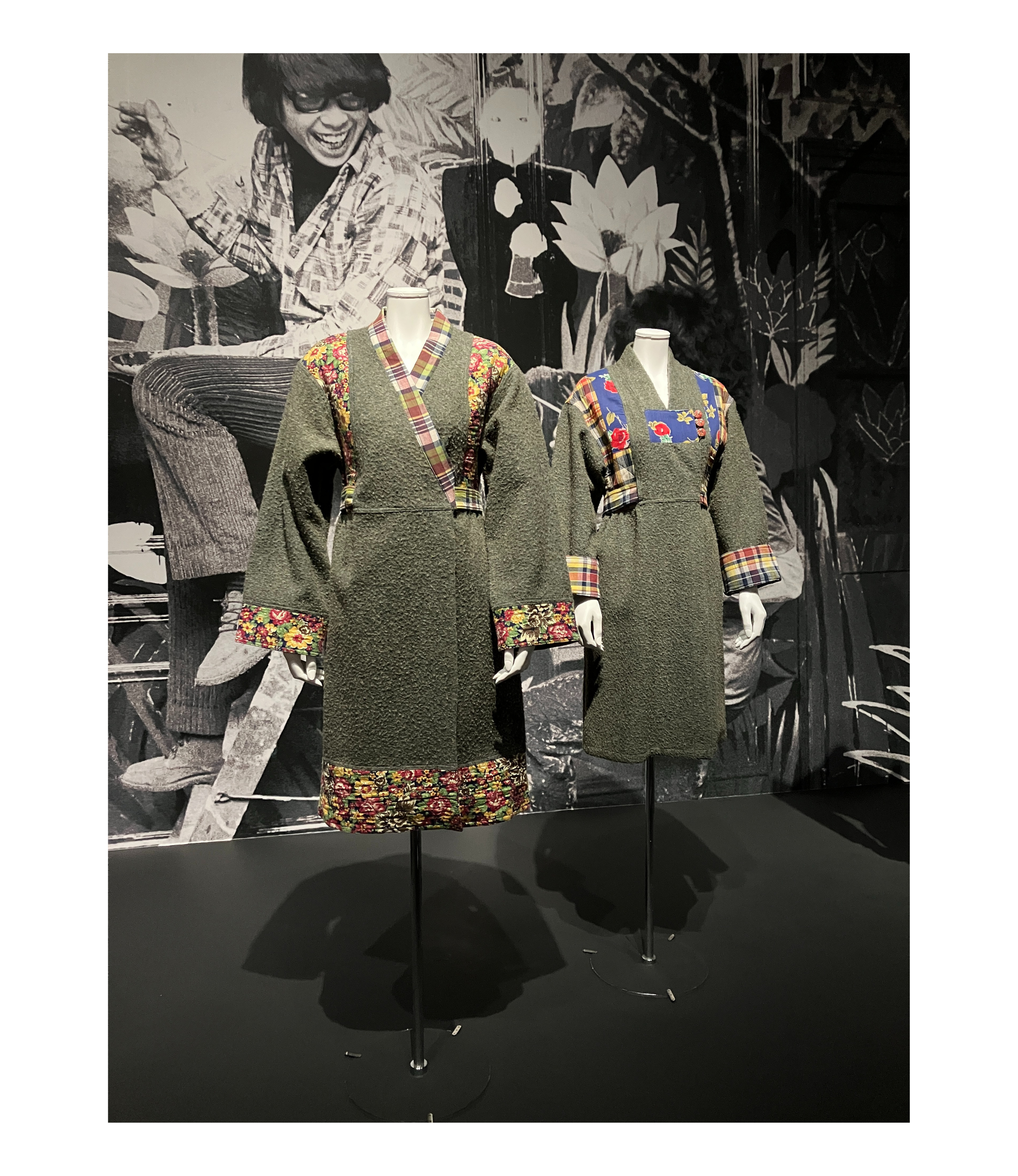
  • Postcards from KENZO’s Journeys

    This substantial exhibition(12 April 2025 – 21 July 2025), held in Kenzo Takada’s hometown of Himeji in Japan brings together some of the designer’s most iconic collections from the 1970s through the 2000s—up until his passing.

    Captivated by Paris, a young Japanese man launched a small boutique called Jungle Jap with close friends in 1970. Before long, he was unveiling full collections at venues such as Galerie Vivienne.

    Kenzo’s Graduation works for Bunka Fashion College, and Award-winning works for the Japanese fashion magazine Soen, 1960

    Kenzo’s early collection in Paris has sense of Japanese motifs, especially materials, like cotton, which had been believed for informal wears in Western nations. Kenzo was called ‘Poet of Cotton’ at that time.

    Dresses made with Japanese Shibori, which was used with techniques tie-dyed cotton, Spring/ Summer, 1971


    Motifs like jungles and vivid flowers—now synonymous with the name “KENZO”—are widely recognised as his signature imagery.
    Yet this exhibition offers a glimpse into the remarkable diversity of inspirations that fueled his creativity.

    According to Tsutomu Sasaki, who worked in KENZO’s studio for many years, many of the early collections began with journeys.Team members would freely travel, bringing back photographs or objects that had captured their imagination. These would be shared in the studio, forming the seeds of future collections.
    The exoticism that characterised KENZO’s early work often resembled postcards from distant lands—designs that reflected a reinterpreted sense of “ethnicity,” constructed through the eyes of someone who had truly experienced other cultures.

    Dress, Autumn/Winter, 1975-1976

    In other collections, inspiration came from antique markets. KENZO actively embraced this approach long before it became widespread among designers.
    A number of eccentric 1980s looks, made with lavish faux fur, are said to have been inspired by Arthur Rackham’s drawings for the Grimm fairy tale Allerleirauh.

    Cat’s Skin from Allerleirauh illustrated by Arthur Rackham (1867-1939)
    Faux fur coat inspired from Arthur Rackham’s drawings , Autumn/Winter, 1980s

    French bandes dessinées (comics), trompe-l’œil, Western clerical vestments, and even the all-female Takarazuka Revue from Kansai, Japan—KENZO’s work was a playful treasure trove of global cultural references.

    From bandes dessinées collection, Autumn/Winter, 1979-1980
    European-vestment-inspired blouses and skirts, Autumn/Winter, 1978-1979
    Toy-soldier-inspired jacket, Autumn/Winter, 1970s
    Costumes for The Lady of Jewels, Takarazuka Revue, 1992


    His boundless sense of playfulness not only defined his brand’s identity, but also helped him carve out a unique space in Japan’s fashion world during the 1980s and 1990s, when mode fashion dominated the scene.

    Photos by author